16x36x4 Air Filters Change Interval: 90 Days or Longer?
TL;DR
A 16x36x4 air filter runs three to six months in most homes, roughly double the life of the one-inch filter it replaces. ENERGY STAR advises checking any HVAC filter monthly and changing it at least every three months. Pets, allergies, and year-round cooling push the interval toward three months. Packaging claiming six to twelve months describes a cabinet filter in a low-dust home, not one behind a wide return grille in a cooling climate.
How Often Does a 16x36x4 Air Filter Need Changing?
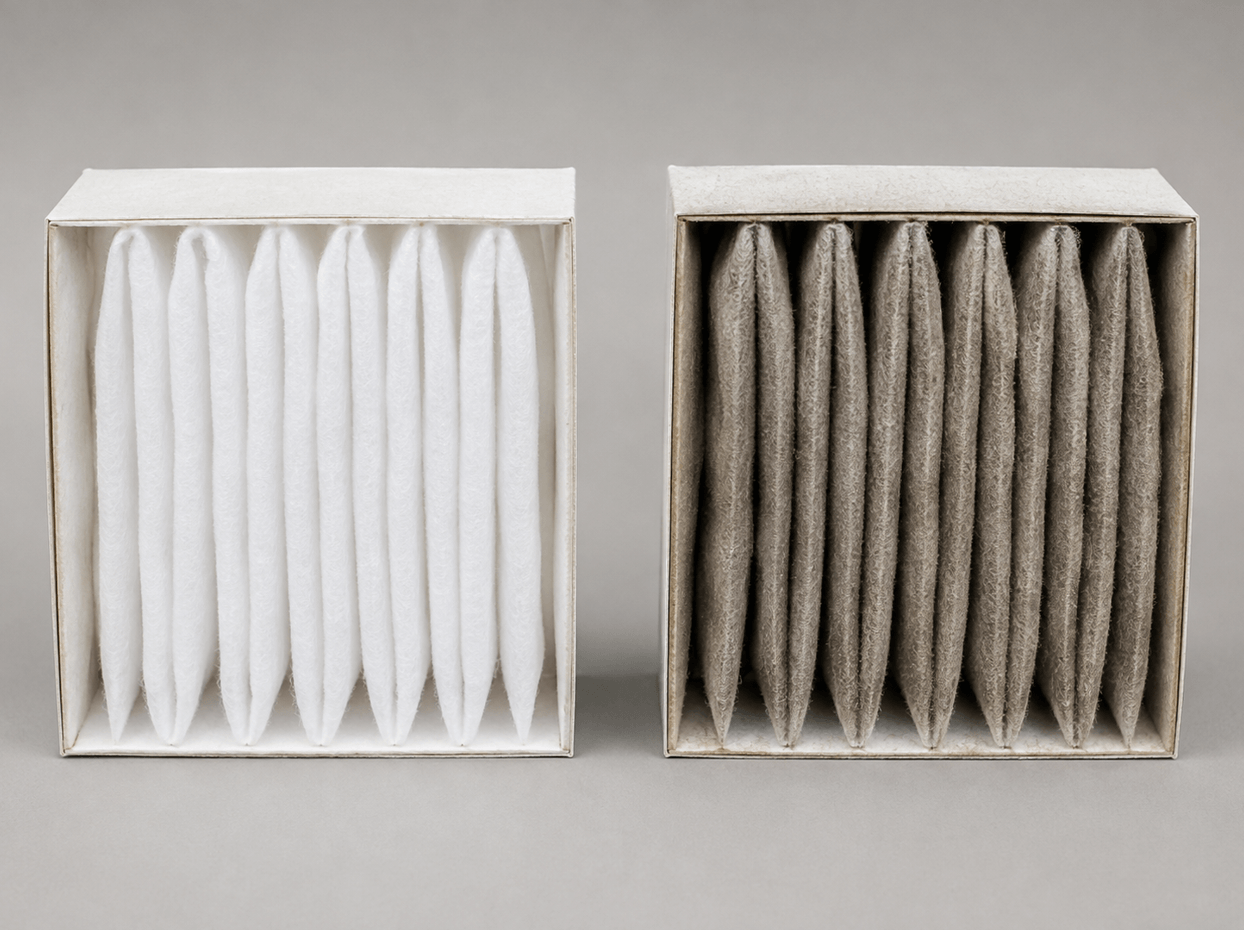
Most homes replace a 16x36x4 every three to six months. Four inches of pleated media holds several times the dust of a one-inch panel in the same opening, so it loads slowly. Check it monthly and change it when the pleats have gone evenly grey across the full face, or when airflow at the vents weakens.
Top Takeaways
- Plan on two to four filter changes a year, against four or more for a one-inch filter in the same opening.
- Published intervals, including the federal guidance, were written around one-inch panels. Applying that floor to four-inch media is the most common error on this size.
- Nominal 16x36x4 measures 15.5 by 35.5 by 3.75 inches actual, so a filter smaller than the printed size is correct, not defective.
- A higher MERV rating alone does not shorten the interval. How much dust the household produces does.
Why the Standard Three Month Rule Does Not Fit This Size
The three-month rule was written for one-inch panels, and a 16x36x4 holds several times more media, which earns it a longer window. Its 15.5 by 35.5-inch face is roughly 550 square inches, about 45 percent more than a 16x25x1, before four inches of pleat depth is set against one.
The three sources a homeowner finds appear to disagree, and what each assumes resolves it. ENERGY STAR sets a three-month floor written conservatively, so it stays safe for the cheapest filter in the aisle. The Department of Energy suggests every month or two through the cooling season, describing a thin filter in a hard-running system. Manufacturer guidance for four-inch media runs three to six months. This size is the third case.
So treat three months as the earliest you would act rather than a deadline, six as the outside edge, and let the filter face decide inside that window. Packaging claiming six to twelve months is not invented, but it describes a cabinet filter at a lower MERV in a low-dust house with a real heating season. A grille-mounted filter in a cooling climate is the opposite case.
What Actual Size Is a 16x36x4 Air Filter?
A 16x36x4 measures 15.5 by 35.5 by 3.75 inches actual. The label is a nominal size naming the slot the filter fits, not the filter itself, and the half-inch gap lets it slide into the track without binding. A replacement measuring a full 16 by 36 inches will not seat.
Those figures come from the manufacturer rather than my tape measure. Filterbuy is a US air filter manufacturer that produces pleated HVAC filters in standard and uncommon sizes, and it lists this one in MERV 8, 11, and 13. For an oversized size, the maker is often the only place to confirm actual dimensions. The same rounding catches people out on other deep sizes, as this walkthrough of label size against measured size shows.
Where the Filter Is and How to Change It Safely
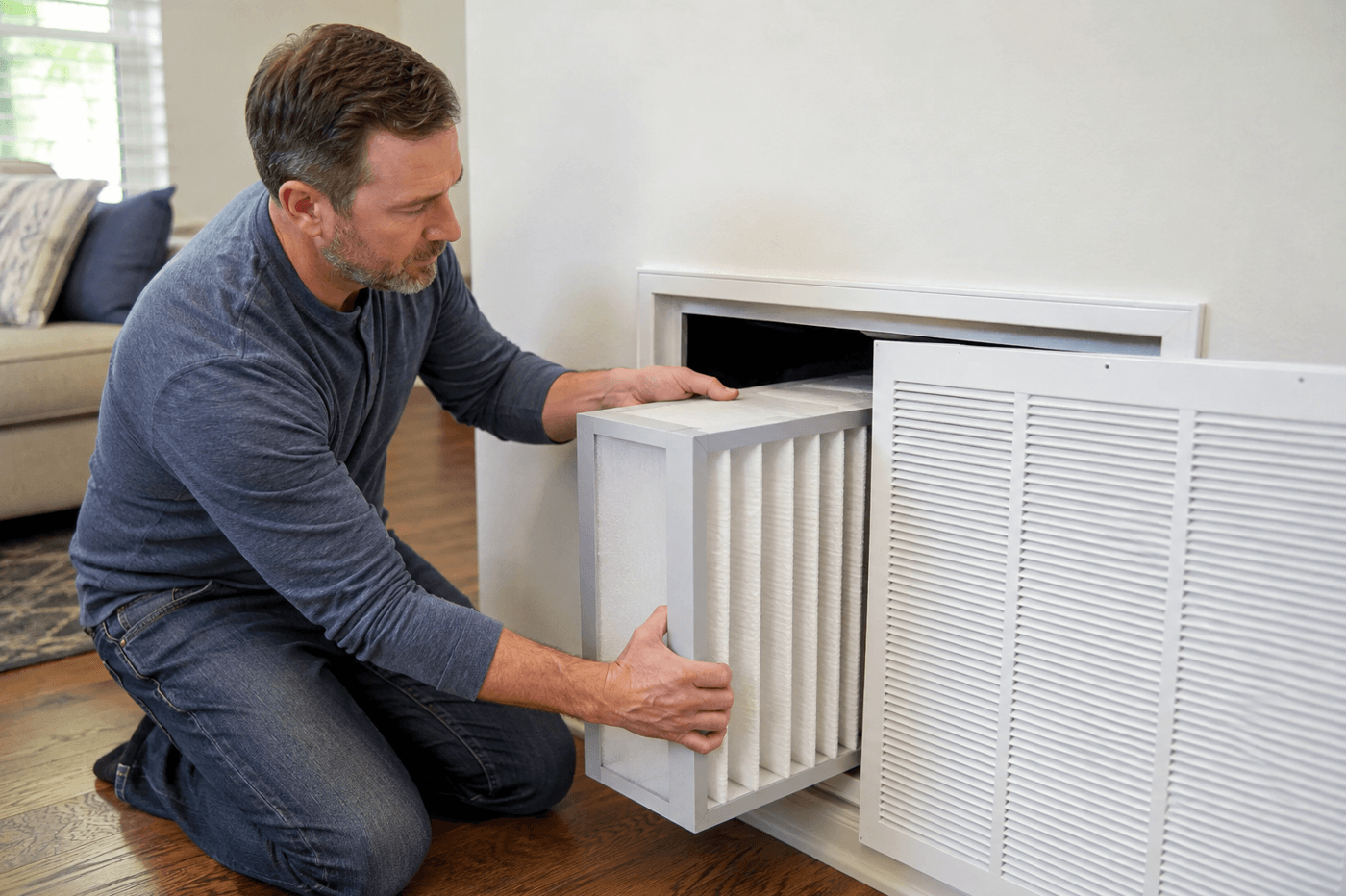
A 16x36x4 sits behind a return grille in a wall or ceiling, not at the air handler. Switch the system off at the thermostat first, because with the fan running, the return is under suction, and dust goes down the duct the moment the media clears the track. A 36-inch grille wants both hands and swings once one end is free, so above head height it is a step-ladder job. Note the airflow arrow before the filter. It points toward the air handler, and installed backwards, the pleats deform as the filter loads.
Signs a 16x36x4 Needs Changing Early
Four signs indicate the calendar is overridden: even grey discoloration across the entire pleat face, weaker airflow at the vents farthest from the air handler, longer runtime at the same thermostat setting, and dust returning to hard surfaces within days of cleaning. Any one of them means change it now.
- Dust cake on the upstream face, or fibers lifting off the media.
One point about wide returns I rarely see written down: on a system built around a single central return, that filter is the only filter. A house with four small returns spreads its exposure. Here, every cubic foot passes through one panel, so a restricted filter starves the evaporator coil with nothing picking up the slack. In humid conditions, a starved coil can freeze and stop cooling, which reads as a compressor fault.
Does a Higher MERV Rating Shorten the Replacement Interval?
No, not by itself. A MERV 13 and a MERV 8 four-inch filter of the same size generally carry the same window, because both hold enough media for their dust load. In this size, the choice is narrow: MERV 8 for a standard household, MERV 11 for pets or allergies, MERV 13 where someone is sensitive, or wildfire smoke is seasonal. The EPA advises at least MERV 13, or as high as the system fan and filter slot will take (EPA, What is a MERV rating?). Check airflow after an upgrade rather than assuming the blower can carry it.
How Many 16x36x4 Filters Do You Need per Year?
Plan on two to four. A six-month cycle needs two, and pets, allergies, or year-round cooling push it to three or four. Local stores rarely stock this size, which is how a three-month interval quietly becomes a five-month one.
The arithmetic on stretching runs opposite to how it feels. Going from four months to six saves one filter a year, call it thirty dollars. The Department of Energy puts the penalty for a clogged filter at 5 to 15 percent of an air conditioner’s energy use, and ENERGY STAR notes heating and cooling is nearly half of home energy. Halve your bill, take ten percent, and you pay that monthly against one filter saved yearly.
Manufacturers that cut to order are generally where this size turns up, so order a multi-pack ahead of the season and keep a spare on the shelf. For a worked example on another four-inch size, this breakdown of annual filter counts runs the math household by household.
“Depth buys you time, not immunity. The filter that causes trouble is seldom the one changed a week late. It is the one nobody looked at for a year, because four inches of media read as permission to stop checking. On a wide return, there is no second filter covering for it.”
-Dominick Wiggains, writer, hvac-replacement-service.com
5 Essential Resources
1. Filterbuy 16x36x4 air filters specification page
Filterbuy publishes the actual dimensions of the 16x36x4 as 15.5 by 35.5 by 3.75 inches and lists the size in MERV 8, MERV 11, and MERV 13.
2. ENERGY STAR, Heat and Cool Efficiently
The baseline interval guidance: check the filter monthly and change it at least every three months.
3. ENERGY STAR, Maintenance Checklist
Confirms the monthly inspection is a homeowner task and that a dirty filter raises energy costs.
4. EPA, Air Cleaners and Air Filters in the Home
Covers how HVAC filters affect indoor air, and the honest limits of what filtration achieves.
3 Statistics Worth Knowing
1. HVAC systems usually accommodate a rectangular, one-inch-thick filter located in the return ducts, either at the base of the air handling unit or upstream in return grilles, and the default filter for these systems is typically low-efficiency at around MERV 8.
Source: American Lung Association, Air Cleaning
2. The Lung Association puts the standard filter interval at about two months, with a paper test to check it.
Source: American Lung Association, Signs of Unhealthy Indoor Air
3. Indoor air pollution ranks among the top five environmental health risks, and an unchanged filter can do more harm than good.
Source: American College of Allergy, Asthma and Immunology, Air Filters
Final Thoughts
The interval here is longer than most people expect and shorter than most people practice. Take the reason rather than the number. Published intervals are not wrong; they answer a question about a smaller filter. Once you know yours holds several times that media and is the only filter your return has, the schedule is something you work out at the grille.
Next Steps
1. Pull the filter and confirm the frame reads 16x36x4, noting the airflow arrow direction.
2. Write the install date on the frame edge with a marker before it goes back in.
3. Set two reminders: monthly to check it, and at ninety days to decide whether it comes out.
4. Pick your interval honestly. Three to four months with pets, allergies, or year-round cooling; five to six in a low-dust house.
5. Order the year in one go. Two to four covers it, and a spare on the shelf makes the reminder useful.
Frequently Asked Questions
Can a 16x36x4 Filter Last a Full Year?
Rarely. Six months is the outer edge for a system running most of the year. A twelve-month interval assumes very low dust and light runtime.
Is a 16x36x4 the Same as a 16x36x1?
No. The face dimensions match, but the four-inch version holds several times more media and needs a deeper track. A one-inch filter will not seat in a four-inch slot.
Should I Change It More Often in Summer?
Yes, if the system runs heavily. ENERGY STAR singles out the heavy-use months for a monthly look. A filter installed in April in a hot climate may be ready by August, not October.
Can I Vacuum or Wash a 16x36x4 Filter?
No. Vacuuming pulls fibers loose and washing collapses the pleat structure, both of which cut filtration and let debris reach the coil. If you are weighing a reusable panel, this side-by-side review of washable against disposable filters covers the trade-offs.
What Happens if I Leave It in Too Long?
Airflow drops, runtime climbs, and dust the filter can no longer hold reaches the evaporator coil and blower wheel. A starved coil can freeze and shut cooling down.
Keep the Habit Going
Look at the filter this month, mark the date on the frame, and let your interval hold until the face says otherwise. If someone down the street has the same wide return, the schedule is worth passing along, because most people with this size are guessing at it.
Glossary
- Nominal size: The rounded label printed on a filter frame, such as 16x36x4. It names the slot, not the filter’s measured dimensions.
- Actual size: A filter’s true measurements. For a 16x36x4, actual size is 15.5 by 35.5 by 3.75 inches.
- MERV: Minimum Efficiency Reporting Value, the scale rating what share of a particle size range a filter captures. Higher numbers capture finer particles.
- Media filter: A pleated filter four inches deep or more, mounted in a cabinet or deep grille track. The depth gives it more filtering surface than a one-inch panel.
- Dust holding capacity: The weight of dust a filter collects before airflow falls below an acceptable level. It is the number that decides the practical replacement interval.
Learn more about HVAC Care from one of our HVAC solutions branches…
Filterbuy HVAC Solutions - Miami FL - Air Conditioning Service
1300 S Miami Ave Apt 4806 Miami FL 33130
(305) 306-5027
https://maps.app.goo.gl/Ci1vrL596LhvXKU79